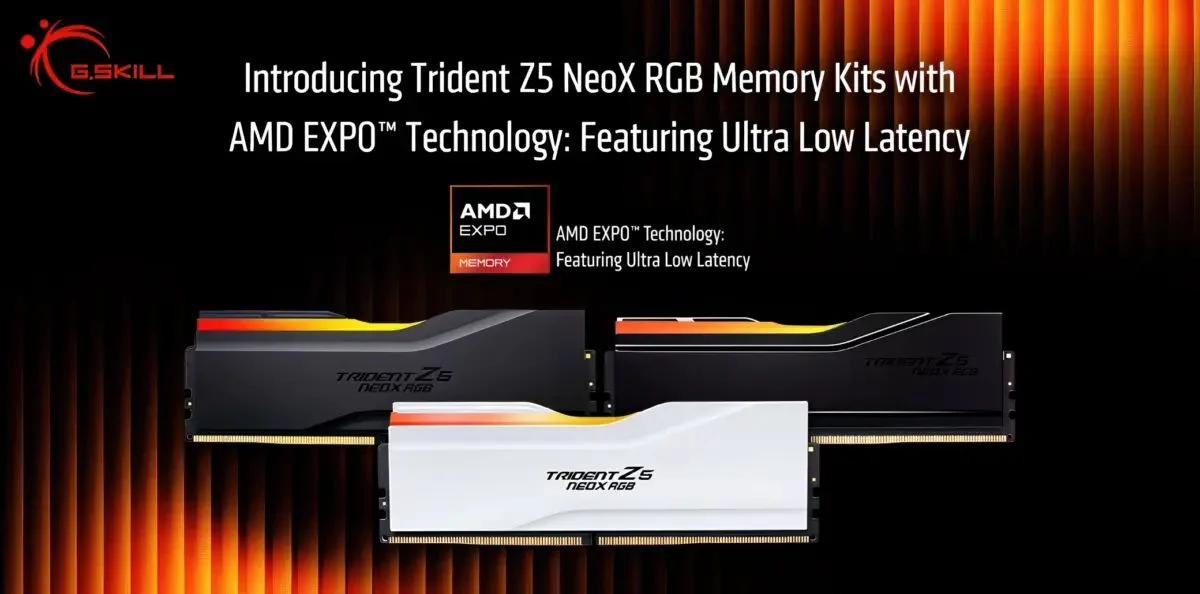
Back during Computex 2026, AMD introduced EXPO Ultra Low Latency (ULL) DDR5 RAM as part of its portfolio for this year, promising as much as a 4% boost in gaming performance over the standard EXPO RAM. Well, those memory kits have begun rolling out and good Gods alive, they are definitely commanding a premium.
In the case of G.Skill’s Trident Z5 NeoX DDR5 memory kits (courtesy of Tom’s Hardware) in the US, a 2-piece kit of 32GB DDR5-6000 CAS28 starts from US$999.99 (~RM4,074). Compared to the standard kit (read: non-ULL), Tom’s Hardware calculates that as a 79% increase.
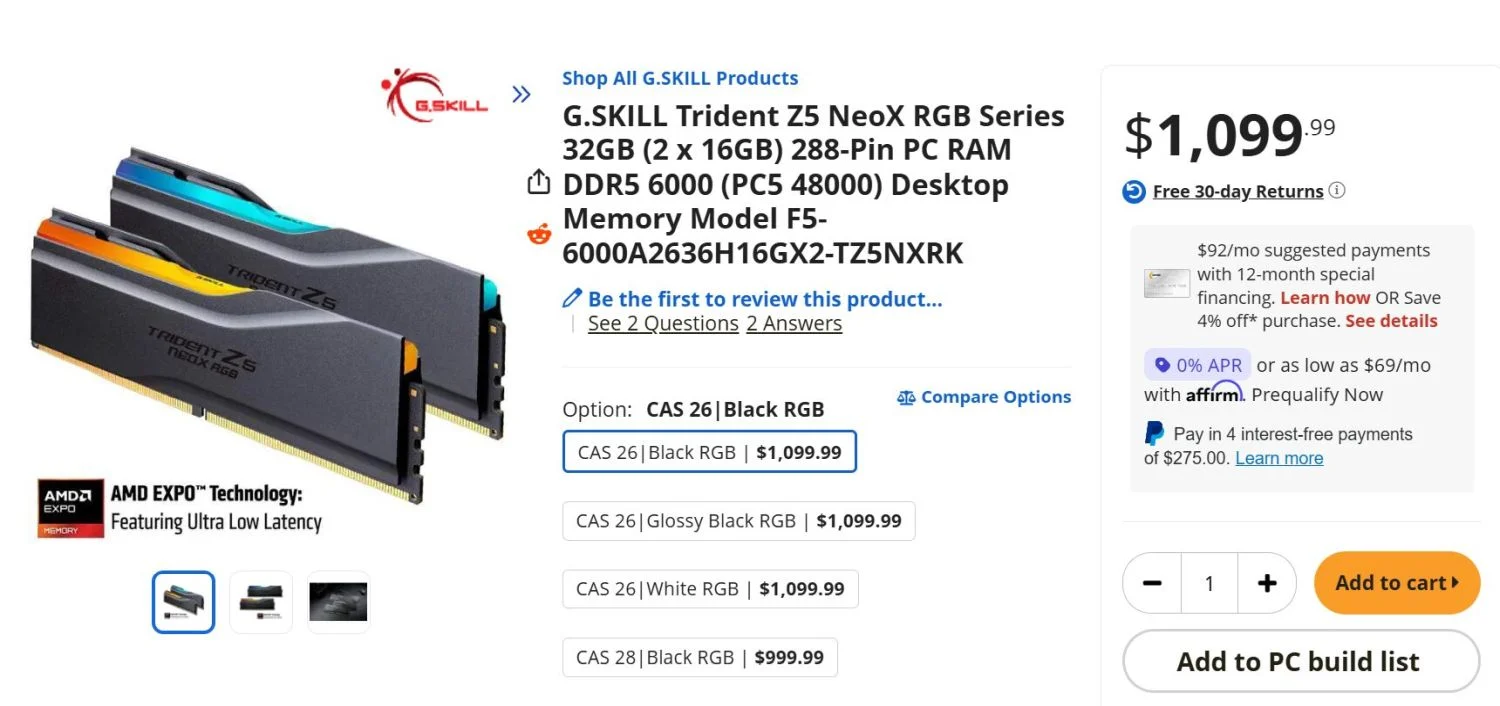
The timings of these new EXPO ULL DDR5 RAM kits are also a determining factor in the price. Basically, the tighter and faster the timings, the more you pay. And the looser the timings are, the less you fork out. For Trident Z5 NeoX with CAS30 and CAS36 timings, they currently retail for an average of US$619.99 (~RM2,526) and US$549.99 (~RM2,241), respectively.
On a sidebar, it’s hard not to say that at those prices, you could actually purchase a couple of other components for a new PC, and that’s with the current price of memory and storage taken into consideration.
The difference in timings between ULL and non-ULL kits is basically in the tRAS cycles. The standard kits usually complete in 96 cycles; memory kits such as the Trident Z5 NeoX kits do it in 32 cycles. At least, this is the case of the CAS26, CAS28, and CAS30 variants. For the CAS36 kits, it’s done in 76 cycles. For another matter, the new kits also operate under lower voltages. Specifically, the ULL CAS26 and CAS28 kits run at 1.35V, while the CAS30 and CAS36 kits stay the same at 1.35V.
That said, AMD has made it clear that getting EXPO ULL RAM isn’t something you can just pick up on a whim. Much like the launch of non-binary RAM, users seeking to become early adopters of the memory module will need to ensure that they have a compatible motherboard and a supported BIOS version on said motherboard that allows users to enable the profile.
(Source: Tom’s Hardware, Videocardz)