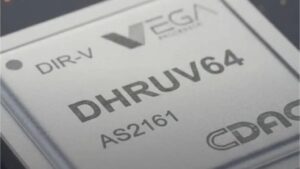
India’s Centre for Development of Advanced Computing (CDAC) revealed its most advanced processor yet, the DHRUV64. The country’s premiere R&D hailed this processor to be a “reliable” product.
For those curious: the DHRUV64 is a 1.0GHz, 64-bit dual-core microprocessor that’s based on the RISC-V architecture. CDAC did not reveal how much power the chip consumes, nor its licensing plans and manufacturing readiness.
On the surface, it may seem quite like a basic chip, and it is. Specs like this aren’t even close to overthrowing the established titans of the industry. However, this chipset is actually far more important and significant than meets the eye. So let’s break it down.
What Is DHRUV64 And What Is It For?
The DHRUV64 isn’t just India’s most advanced processor yet; it is also the country’s first-ever 1.0GHz 64-bit microprocessor. According to the Press Information Bureau (PIB) of India, the processor is “built with modern architectural features” and can deliver “higher efficiency, enhanced multitasking capability and improved reliability”.
PIB says that these upcoming processors will bolster India’s domestic RISC-V ecosystem and broaden the range of indigenous solutions available for both strategic and commercial applications.
The government body also stated the DHRUV64’s “advanced design enables seamless integration with a wide range of external hardware systems”. PIB said that the chip is best suited for “5G infrastructure, automotive systems, consumer electronics, industrial automation, and the Internet of Things (IoT)”.
Why Is It Significant?
As you might have guessed, any other chip worth its salt can easily accomplish what the PIB claims the DHRUV64 can do and then some. However, what makes this chip important is that it demonstrates India’s ability to develop its own processor. The fact that it was able to achieve this in such a short period of time is also noteworthy.
DHRUV64 will support prototype development for new system architectures at a lower cost. Furthermore, the PIB said that the success of the chip accelerates the CDAC’s roadmap toward building stronger, more powerful processors. To put it simply, DHRUV64 is the cornerstone for future Indian-developed SoCs moving forward.
The next chips in the pipeline are the Dhanush and the Dhanush+ processors. PIB says that these upcoming processors will bolster India’s domestic RISC-V ecosystem and broaden the range of indigenous solutions for both strategic and commercial applications. That said, it’s important to note that both the Dhanush and Dhanush+ processors are now under development.
What Is Its Near-Term Impact?
According to The Register, the Indian government is touting the chipset as proof that its push to build a domestic semiconductor industry is gaining momentum. The publication noted that the government began a “concentrated push to build locally designed chips” based on the RISC-V architecture in 2020. DD News adds that DHRUV64 strengthens India’s semiconductor industry, “supports critical digital infrastructure”, and helps “reduce long-term reliance” on foreign chips.
However, because CDAC has disclosed few details or plans, it is not yet possible to gauge DHRUV64’s real-world impact on the country or the broader processor market. This is especially true since, at present, it primarily serves as a tool for developing more powerful SoCs.
As The Register notes, India aims to become a global electronics and semiconductor hub. Homegrown processors like DHRUV64 will be vital for technological sovereignty and long-term industrial growth. Perhaps it will remain that way until CDAC reveals any major plans for the chipset.
(Source: Press Information Bureau, The Register, DD News)