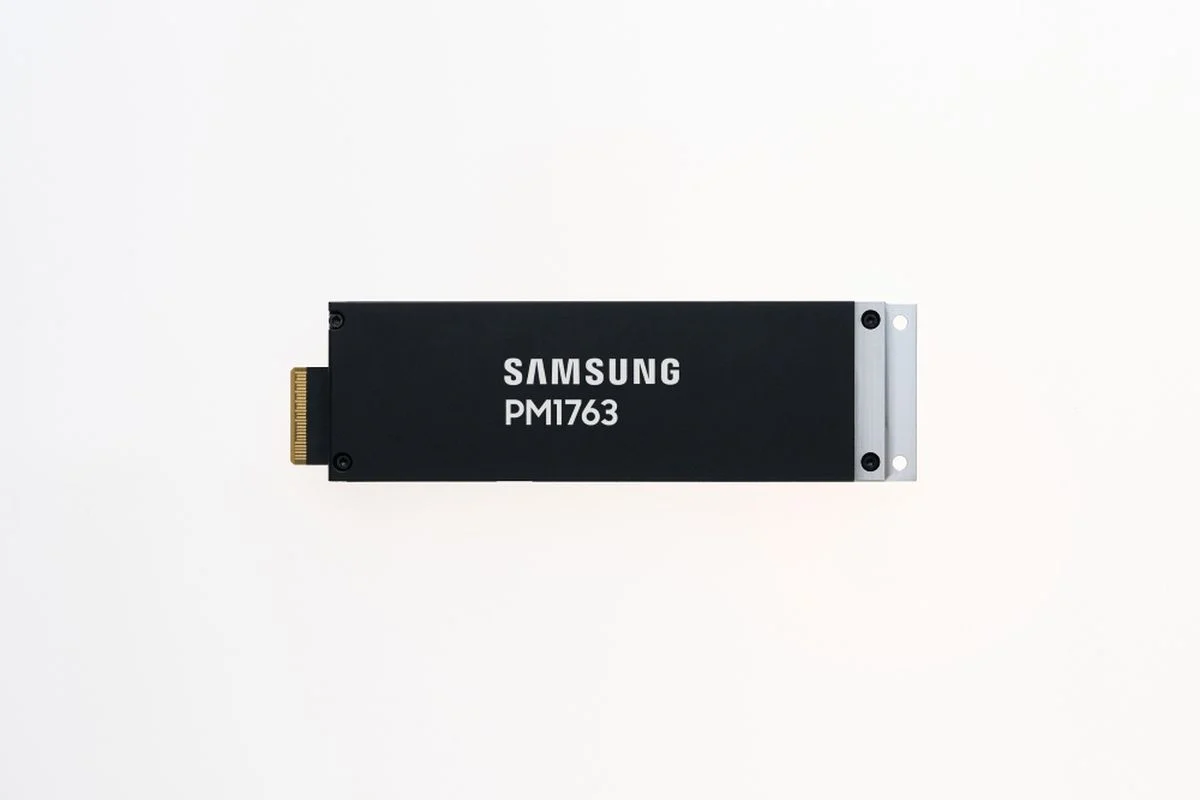
Samsung has announced that it has entered mass production of its new PM1763 SSDs designed to take on the demands of AI data centres and high-performance computing environments. With a PCle 6.0 interface, it is double the throughput of its predecessors, reaching average sequential read and write speeds of up to 28.4 GB/s and 21.9GB/s, respectively.
Diving deeper into the upgrade, the Samsung PM1763 is available in 4TB, 8TB, and 16TB, with the 16TB model delivering read and write speeds of up to 28.4 GB/s and 21.9 GB/s, respectively. With transfer speeds this high, the new SSDs can transfer a 40GB large language model (LLM) in just 1.4 seconds, cutting transfer times nearly in half compared to the PCIe Gen 5-based PM1753, which takes around 2.7 seconds.
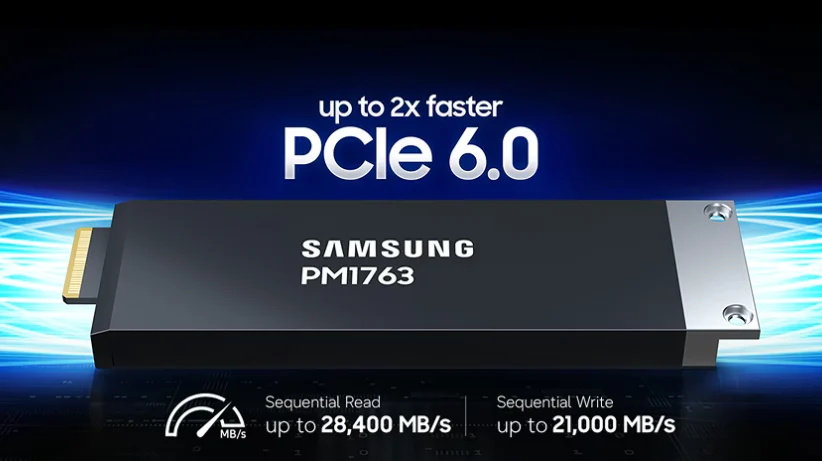
Adding on to that, Samsung’s Gen 6 SSDs combine ninth-generation V-NAND and a new 4mm controller, delivering up to 1.8 times better power efficiency than the previous generation. The company also claims that this improvement helps in reducing power consumption and lowering operating costs in data centres.
Beyond raw performance, Samsung is also focused on efficiency and reliability. The new SSDs are designed for liquid-cooled server environments through direct-to-chip cooling technology to improve thermal management. They are also built for reliable, long-term operation by delivering consistent performance and stability across heavy workloads such as AI inference, databases, and data analytics.
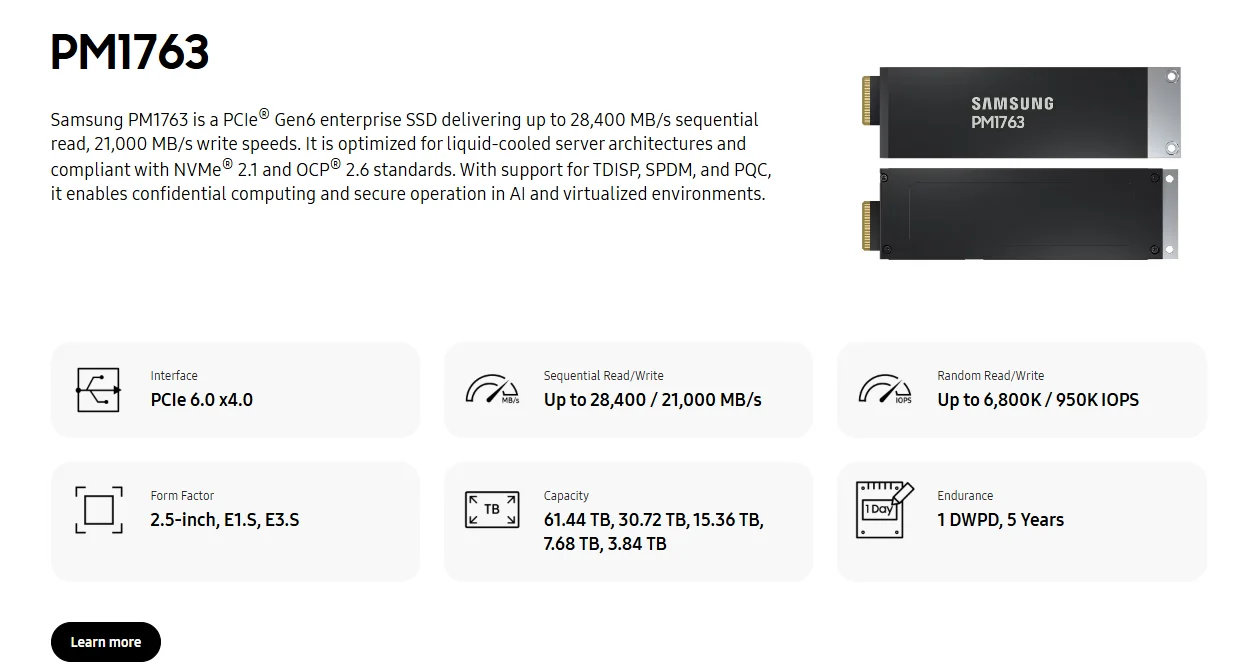
The PM1763 will initially be available in the capacities mentioned above, though Samsung could potentially expand the lineup to include 32TB and 64TB models, as it listed 30.72TB and 61.44TB options on its product page. The drives also support E1.S and E3.S form factors with NVMe 2.1 and OCP 2.6 compatibility.
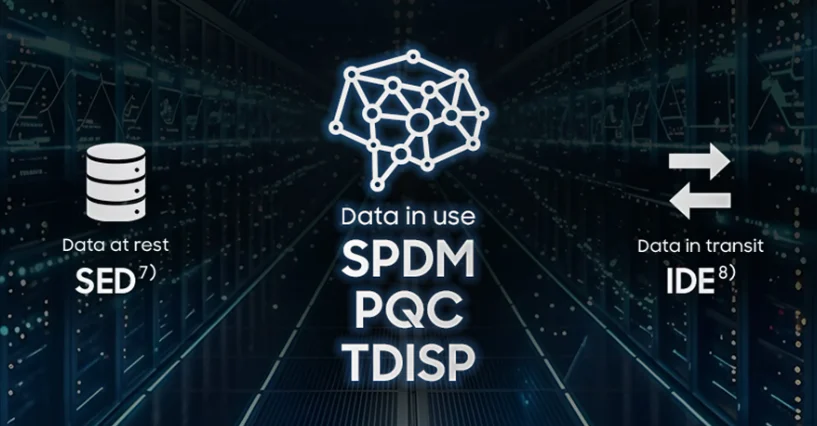
Other than performance improvements, Samsung is strengthening the PM1763’s security capabilities with post-quantum cryptography algorithms designed for the next era of computing. These protections aim to address future risks posed by quantum computers, which have the potential to break today’s widely used encryption methods. It also features support for SPDM and TDISP, which provides stronger hardware authentication and allows encrypted virtual machines to securely interact with hardware components without compromising data pathways.
Overall, AI is advancing faster than ever, but behind every breakthrough is hardware evolving just as quickly to make it possible. Samsung’s PM1763 SSDs mark a major step forward for enterprise storage, delivering faster performance and improved efficiency compared to PCIe 5.0 drives. However, they may not hold the title of fastest SSDs for long, with PCIe 8.0 expected to push speeds even further in 2028.
(Source: Samsung)
Natrisha contributed to this article.